Wednesday, May 28, 2008
Sunday, March 09, 2008
"A l'ombre des jeunes filles, en fleurs" (published around 1918).
by the famous French author Marcel Proust (1871-1922)
This is a nice excerpt from Proust's book where he talks about the difference between using one's native language and another language.
Page 172:
"Dans une langue que nous savons, nous avons substitué a l'opacité des sons la transparences des idées. Mais une langue que nous ne savons pas est un palais clos dans lequel celle que nous aimons peut nous tromper, sans que, restés au-dehors et désespérément crispés dans notre impuissance, nous parvenions á rien voir, à rien empêcher."
Glossary of terms:
tromper = deceive
désespérément = despairingly
crispés = exasperated
empêcher = stop, hinder
Page 200:
This is his description of how love effects us:
"Quand on aime, l'amour est trop grand pour pouvoir être contenu tout entier en nous ; il irradie vers la personne aimée, rencontre en elle une surface qui l'arrête, le force á revenir vers son point de départ et c'est ce choc en retour de notre propre tendresse que nous appelons les sentiments de l'autre et qui nous charme plus qu'à l'aller, parce que nous ne reconnaissons pas qu'elle vient de nous."
Friday, February 22, 2008
Saturday, December 15, 2007
Extract from a book I read recently. The extract has some interesting information on neuroscience. The book is called "The Echo Maker" by Richard Powers. Published in 2006 by Vintage.
Page 449:
"… A few years back, Giacomo Rizzolati's group in
A part of the brain that did the physical things was being cannibalized for making imaginary representations. Science had at last laid bare the neurological basis of empathy: brain maps, mapping other mapping brains. One human wit quickly labeled the find the monkey-see monkey-do neurons, and all others followed suit. Imaging and EEG soon revealed that humans too, were crawling with mirror neurons. Images of moving muscles made symbolic muscles move, and muscles in symbol moved muscle tissue.
Researchers rushed to flesh out the staggering find. The mirror-neuron system extended beyond this surveillance and performance of movement. It grew tendrils, snaking into all sorts of higher cognitive processes. It played roles in speech and learning, facial decoding, threat analysis, the understanding of intention, the perception of and response to emotions, social intelligence, and theory of mind. …"
Saturday, November 17, 2007
Notes on the book “The Road” by Cormac McCarthy, Copyright 2006
Pages 297-299
Before the father dies, he talks to his son. There are some interesting thoughts here on the imagination and prayer.
"The boy thought he smelled wert ash on the wind. He went up the road and came dragging back a piece of plywood from the roadside trash and he drove sticks into the ground with a rock and made of the plywood a rightly leanto but in the end it didn’t rain. He left the flare pistol and took the revolver with him and he scoured the countryside for anything to eat but he came back empty handed. The man took his hand, wheezing. You must go on, he said. I cant go with you. You need to keep going. You dont know what might be down the road. You were always lucky. You'll be lucky again. You'll see. Just go. It's all right.
I cant.
It's all right. This has been a long time coming. Now it's here. Keep going south. Do everything the way we did it.
You're going to be okay, Papa. You have to. No I'm not. Keep the gun with you at all times. You need to find the good guys. But you cant take any chances. No chances. Do you hear?
I want to be with you.
You cant.
Please.
You cant. You have to carry the fire.
I don’t know how to.
Yes you do.
Is it real? The fire?
Yes it is.
Where is it? I don’t know where it is.
Yes you do. Its inside you. It was always there. I can see it.
Just take me with you. Pease.
I cant.
Please, Papa.
I cant. I cant hold my son dead in my arms.
I thought I could but I cant.
You said you wouldnt ever leave me.
I know. I'm sorry. You have my whole heart. You always did. You're the best guy. You always were. If I'm not here you can still talk to me. You can talk to me and I'll talk to you. You'll see.
Will I hear you?
Yes. You will. You have to make it like talk that you imagine. And you'll hear me. You have to practice. Just don’t give up. Okay?
Okay.
Okay.
I'm really scared Papa.
I know. But you'll be okay. You're going to be lucky. I know you are. I've got to stop talking. I'm going to start coughing again.
It's okay. You don't have to talk. It's okay."
Tuesday, December 12, 2006
I just started to read a bit about the Italian writer Italo Svevo. His real name was Ettore Schmitz, and he wrote some famous books like "La coscienza di Zeno" and "Senilitá."
As an introduction to him I'm reading a book in Italian on him by Giuseppe Antonio Camerino simply called "Svevo." I more or less understand what's going on in the book, and it gets easier the more I read.
Here is a nice quote by Italo Svevo in this book on the intellectual and critical mind on pages 219 and 220:
La vita stessa era come divisa in tanti periodi ben regolati e la sua prevedibilità era una delle probabili cause del mancato rimpianto del passato. Tuttavia la moglie borghese viveva con la capacità di stupirsi di ogni novità presunta: tipico atteggiamento di chi osserva la realtà in modo estremamente semplificato e conformistico, al contrario dello spirito intellettuale e critico, caratterizzato dal dubbio e dall'inquietudine.
<<>– commenta, ad esempio, ancora Ettore – Per quelli non c'è posto. La preghiera a tempo debito è ascoltata lassù, molto spesso non è esaudita ma allora l'uomo ha la coscienza d'aver fatto tutto quello che doveva e può stare tranquillo. E più avanti: Io creato per la ribellione, per l'indifferenza, per la corruzione, sempre ammirato di quello che potrebbe essere e mai ossequiente a quello che è, mi sposai con la convinzione che si stava facendo un nuovissimo esperimenti di sociologia, l'unione di due uguali legati da un'inclinazione che potrebbe essere stata anche momentanea, un'unione da cui la gelosia doveva essere bandita dalla scienza… >>
Glos
prevedibilità being predictable, being foretold
mancato lack of
rimpianto sorrow, regret
passato past
tuttavia however
stupirsi marvel
atteggiamento behavior, attitude
chi who
dubbio doubt, question
inquietudine unease
preghiera prayer
tempo time
a tempo debito all in good time
ascoltata listen
lassù up there
molto spesso very often
esaudita fulfill, answered
ammirato admired
potrebbe able (to)
ossequiente subservient
stava remained, was
legati tie, fasten
bandita ban
* * *
In the Appendix he talks about the "lieu d'aisance," which is <<>> in Italian.
* * *
There is also a nice use of "sui generis" in the Appendix:
on page 418
Che forse questa Storia dello sviluppo della civiltà a Trieste nel secolo presente sia nata come un ampliamento sui generis di quelle prime note sulla vecchia linea tramviaria, in un contesto che riguarda non più soltanto il tramway di Servola, ma anche altri mezzi di comunicazione (si veda nella seconda parte la divertente satira della sorgente civiltà del motore a scoppio) e, più in generale, la stessa concezione del progresso nella Trieste del dopo-guerra?
Glos
sviluppo development, progress
secolo century
ampliamento expansion, enlargement
sui generis (latin) adj, of its own kind; unique
soltanto only
mezzo means
divertente amusing, funny
sorgente source
scoppio explosion
stessa same
Friday, October 13, 2006

Notes on the book “The Temple of Dawn” by Yukio Mishima, published by Penguin Books, 1977
In the book he talks a lot about Buddhism and the evolution of religions in general:
For example on page 93, he writes: “The Greek philosopher Heraclitus, claimed that all things are in flux.”
On page 104, he talks about the Yuishiki school of philosophy which advocates the concept of alayavijnana, “the ultimate consciousness.” Translated by “storehouse consciousness” in Chinese, alaya stores away all “seeds” of the phenomenal world.
Life is active, Alaya consciousness functions. This consciousness is the fruit of all rewards, and it stores all seeds that are the results of all activity. Thus that one is living indicates that alaya is active.
This consciousness is in constant flux like a foaming white waterfall. While the cascade is always visible to our eyes, the water is not the same from minute to minute. New water incessantly pours by, streaming and surging, sending up its misty vapors.
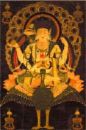
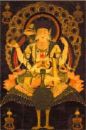
On page 123, he explains the Buddhist Sutra of the Great Golden Peacock Wisdom King, Mahamayurividyarajni. This sutra is supposed to ward off snakes or cure poisoning from their bites. Not only snake poison, but all fevers, all wounds, all pain and suffering were reputed abolished by this sutra. Simply chanting it was sufficient, and the mere thought of the Peacock Wisdom King did away with all fear, enemies, and calamities.
The Peacock Wisdom King in the illustration was a gorgeous and sumptuous figure as though the personification of the peacock itself, so different from the bloody image of Kali, his prototype, with her protruding tongue and her necklace of severed heads.
His magic formula was said to imitate the cry of the peacock – ka-ka-ka-ka-ka-ka-ka-ka-ka-ka-ka-ka – and the mantra, ma ya kitsu ra tei sha ka, meant “Peacock fulfillment.
“ Even the special hand gesture, which was called the “sign of the Buddha Begetter, the Peacock Wisdom King,” and which was made by joining the two hands back to back, the two thumbs and the two little fingers pressed together, was both a description and imitation of the peacock’s majesty. The gesture represented the shape of the peacock, the little fingers being the tail and the thumbs the head, and the rest of the fingers the feathers. The way the middle six fingers moved as the incantation was changed depicted a peacock dancing,..
Page 162
Other books referred to in this book are:
The Honcho monzui, “Compositions of elegance Composed in
The “Essays on
Friday, September 22, 2006
Notes on the book “The Rings of Saturn” by W.G. Sebald, published by Harvill Press,
He talks about the writer Edward FitzGerald:
The writer Edward FitzGerald grew up at the beginning of the 19th century in
The FitzGeralds were an Anglo-Norman family and had lived in
After his studies in Cambridge, Edward kept himself occupied in the main with reading, in a variety of languages, with writing countless letters, with making notes towards a dictionary, with making a compete glossary of all words and phrases relating to the sea and to seafaring and with pasting up scrap books of every conceivable description. He had a particular predilection for the correspondence of bygone ages, such as that of Madame de Sévigné, who became far more real to him than even his friends who were still alive. The only task FitzGerald finished and published in his lifetime was his marvellous rendering of the Rubaiyat of the Persian poet Omar Khayyam, with whom he felt a curiously close affinity across a distance of eight centuries.
Elsewhere he talks about Vicomte de Chateaubriand:
The Vicomte de Chateaubriand spent some time in
Chateaubriand took on the role of tutor and confidant for the vicar’s daughter, Charlotte, and they spent long hours in the afternoon together reading Tasso’s Gerusalemme Liberate and the Vita Nuova. He describes his time in
"stesso sangue, stessa sorte”
in English this means:
"same blood, same destiny"
Monday, June 05, 2006
By Annie Proulx
A nice image from the book:
“His thoughts clogged as if a comb working through his mind had stuck against a snarl.”
And another nice description of a girl daydreaming:
“What was there for Ottaline when the work slacked off? Stare at indigo slants of hail forty miles east, regard the tumbled clouds like merchants’ rags, count out he loves me, he loves me not, in nervous lightning crooked as branchwood through all quarters of the sky.”
A nice spot where she talks about a snow-storm in reverse …
“Thompson, the bar owner, displayed his collection of spurs, coils of rope, worn boots, a couple of saddles, some old woolly chaps so full of moths they looked like snow-storm in reverse in spring, other junk inside the window.”
In another place, she talks about being “wired”, which I think is probably American English for being “tense,” or “wound-up.”
“Around mid-afternoon I’d left them in the calving barn with a bad heifer, gone up to the house to grab an hour of sleep, but I was too tired, way beyond sleep, wired, and after ten minutes I got up and put the coffeepot on, got some cookie dough from the freezer and in a little while there was steaming coffee and hot almond sandies. I put three cups in a cardboard box, the cookies in an insulated sack, and went back out to the calving barn.”
Saturday, April 15, 2006
Reading
Some notes on a book I read recently.
A book by Paul Auster - "The Book of Illusions"
This is an excellent book. Auster refers a lot to the French writer Chateaubriand.
Chateaubriand wrote Mémoires d'outre-tombe which was published in 1848. It has two thousand pages, and is said (in Auster's book) to be the best autobiography ever written.
A suggestion in the book for the translation of Mémoires d'outre-tombe is Memoirs from Beyond the Grave, but it was felt that Memoirs of a dead man might be more like it.
Reference is made to a two-volume edition of Chateaubriand's Mémoires by Pléiade compiled by Levaillant and Moulinier.
Quote from the Mémoires: "Ce lieu me plaît; il a remplacé pou moi les champs paternels"
Other writers, singers, composers, etc. mentioned by Auster: Dashiell Hammett and André Breton; Pergolesi and Mingus; Verdi, Wittgenstein, Villon; Rimbaud, Laura Riding
* *
Philip Roth – in his book "The Plot Against America" – mentions on Page 92 that it was common in the US in the 1940s to refer to meals on menus in restaurants by their French title, e. g. "roast beef au jus" and "pecan pie á la mode."
There are some nice touches in the book "Bad Dirt" by Annie Proulx.
Page 66
He was addicted to what he called "hammer coffee," strong enough to dissolve the handle, float the head.
or on Page 73:
"Them rich pricks are lower than a snake's ass in a wagon track."
and on Page 121:
An elderly widow rancher in Wyoming is talking to a newcomer to Wyoming country from New York, she says to him:
"How's your teeth?" "Pretty sharp?"
"I don't know," says he, nonplussed by the odd question. "Why?"
"Always lookin for somebody help us castrate lambs."
On Page 152 she has a great description of a man with a very large gray beard:
"Here was a man who cared about his beard. Its luteous glow, its fluffed fullness, the mild fragrance of rose petals that wafted from it all declared a pogonophile-meister as Reginald Reynolds might have said."
luteous a deep orange yellow or greenish yellow
pogonophile one who loves beards
Describing the face of a cowboy she writes:
"He bore the traces of acne so severe that his sallow skin, resembled sand drilled by a fast-moving cloudburst."
* *